Fire lane striping requirements in California
What property managers and commercial owners need to know about California fire lane marking standards, enforcement requirements, and the risks of non-compliance.

What property managers and commercial owners need to know about California fire lane marking standards, enforcement requirements, and the risks of non-compliance.
Fire lanes are not just painted lines. They are legally designated emergency access corridors required by the California Fire Code and enforced by local fire authorities.
When fire lane markings are faded, missing, or incorrectly applied, the consequences go beyond a code violation. Delayed emergency response, lost towing authority, and liability exposure are all real outcomes for properties that let these markings slip.
For property managers and commercial facility owners, staying current on fire lane striping requirements is a straightforward way to protect your property, your tenants, and your compliance standing.
A fire lane is a designated pathway that must remain clear at all times to allow emergency vehicles unobstructed access to a building or property. California law, including the California Fire Code (CBC Title 19) and local amendments, requires fire lanes to be clearly marked and maintained so they are visible and enforceable.
Without clearly maintained markings, a fire lane has no legal standing. Vehicles parked in an unmarked or faded fire lane may not be subject to citation or tow, and the property owner may face compliance issues during routine inspections.
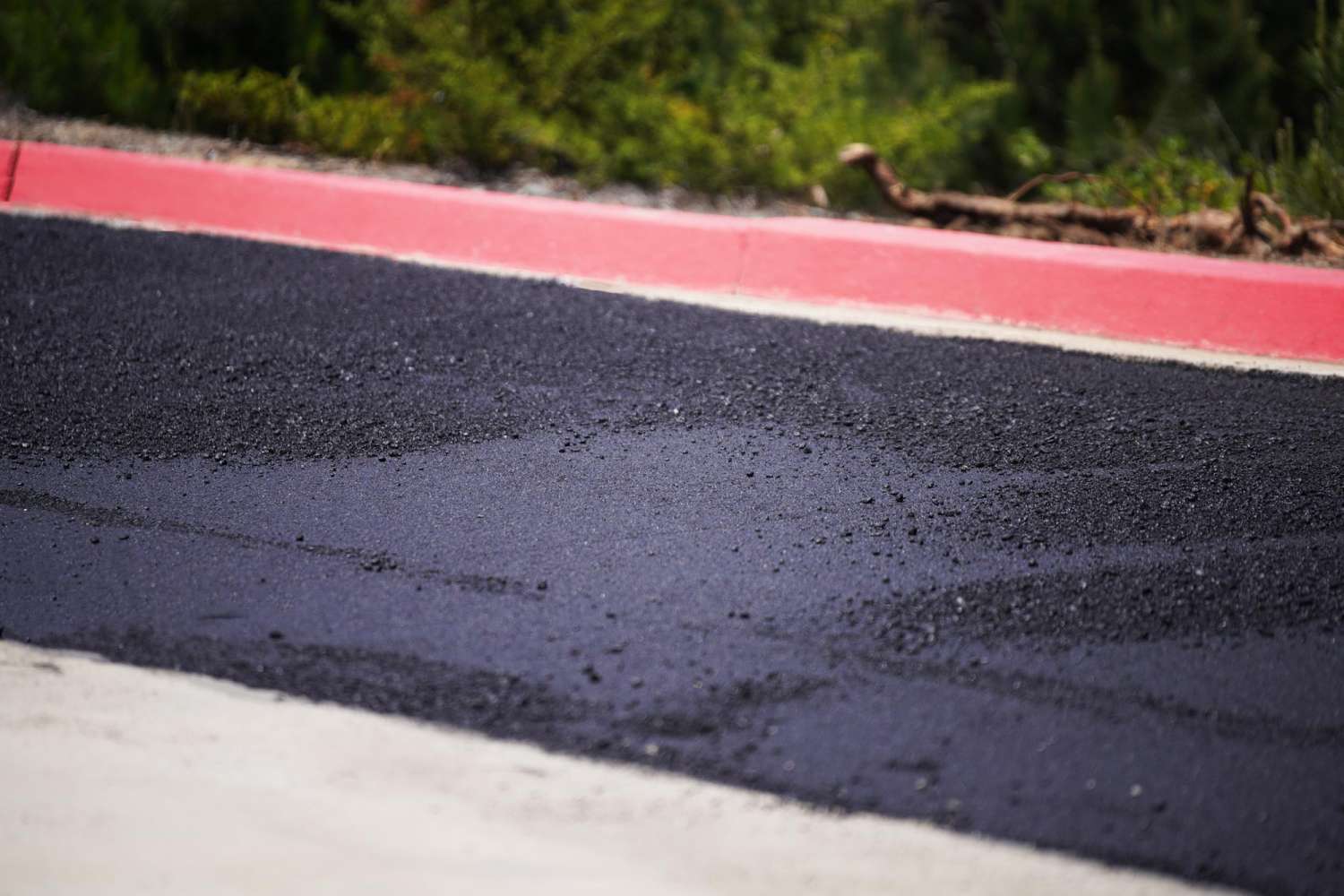
In California, fire lane curbs must be painted red to indicate that no stopping, standing, or parking is permitted at any time. Red is the standard color required in most jurisdictions and is the most universally recognized fire lane indicator.
Red curb paint must remain clearly legible. Faded or chipped paint voids the enforceable status of the fire lane. For commercial properties that rely on active towing enforcement, this is a direct operational concern.
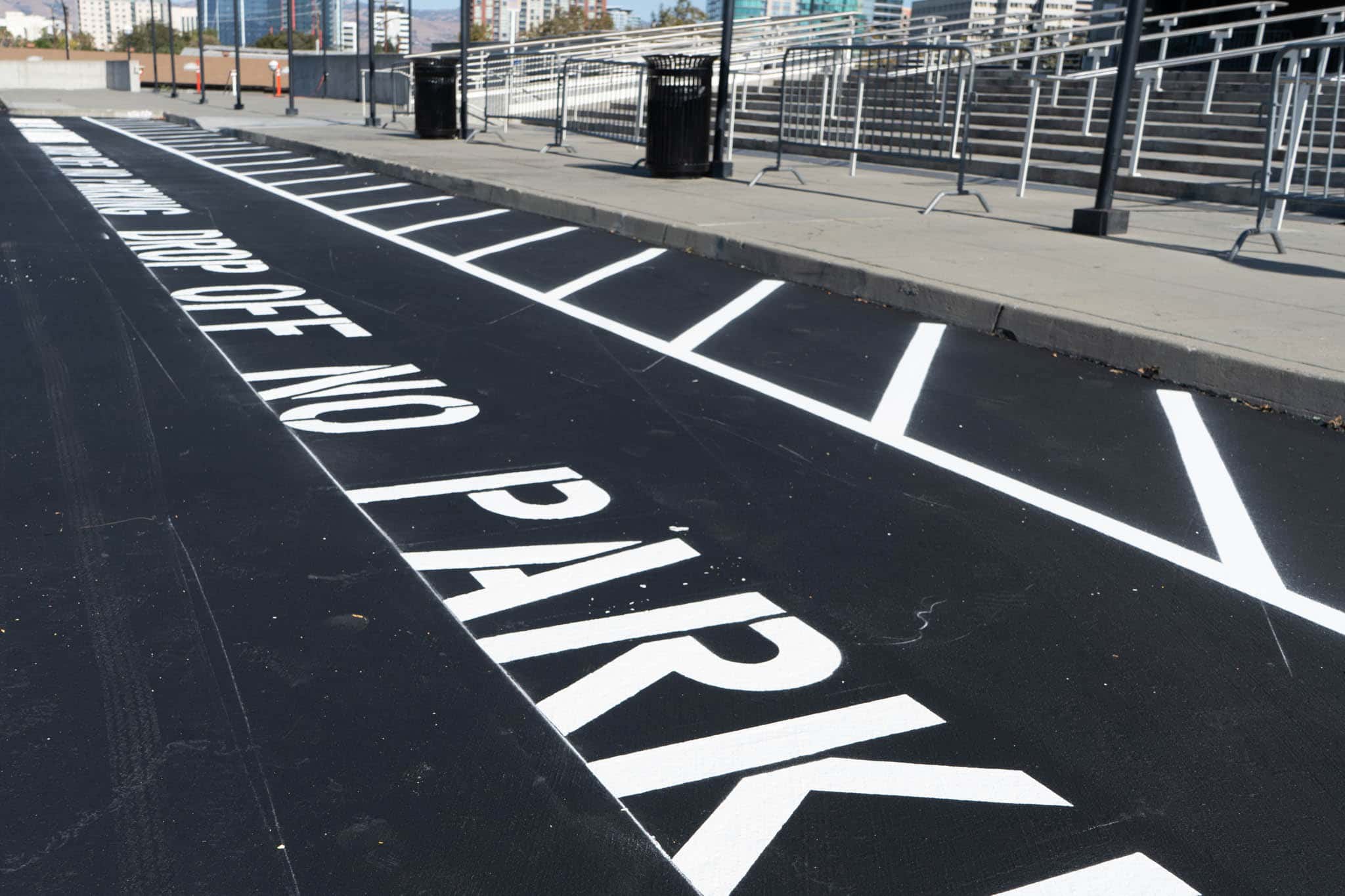
In addition to red curbs, most jurisdictions require the words “FIRE LANE” stenciled directly onto the pavement surface at regular intervals. Text must be clearly visible and readable from the driver seat of an approaching vehicle.
A common standard calls for stenciling every 50 feet in continuous fire lane zones. Some municipalities also require directional arrows to indicate the flow of travel along the lane. Requirements vary by city, so confirming local standards before work begins is important.
Pavement markings alone are not always sufficient. California jurisdictions typically require posted signs reading “NO PARKING FIRE LANE” or equivalent language at each end of a designated fire lane and at intervals not exceeding 75 feet in most California Fire Code adoptions.
Signs must meet visibility, height, and reflectivity standards set by the California Manual on Uniform Traffic Control Devices (CA MUTCD). Without compliant signage, even well-painted markings may not fully satisfy code.
The California Fire Code generally requires fire lanes to maintain a minimum unobstructed width of 20 feet. In some cases, wider clearances are required to accommodate ladder trucks or aerial apparatus. Overhead clearance must typically reach at least 13 feet 6 inches, free of branches, canopies, or signage.
The California Fire Code sets the baseline, but local fire authorities having jurisdiction (AHJ) can and often do adopt more stringent standards. Cities across the Bay Area, Central Valley, and Northern California coastal communities may have specific color codes, stenciling intervals, or signage formats that go beyond state minimums.
At Pacific Surfacing, we coordinate directly with local authorities when needed to confirm that fire lane markings meet current local adoption standards, not just the state baseline. That level of due diligence is part of how we approach every striping project.
Failing to maintain proper fire lane markings creates real exposure for property owners. Common outcomes include:
Fire inspectors regularly include fire lane compliance as part of routine commercial property inspections. It is one of the more commonly cited issues in parking facilities.
In high-traffic commercial lots, pavement stenciling and curb paint can begin fading within two to three years. Lots subject to frequent pressure washing or chemical exposure may see faster deterioration.
The most practical approach is to tie fire lane repainting into your sealcoating cycle. Sealcoat covers all existing markings, which means fire lane stenciling and red curb paint must be reapplied after every sealcoating project. That creates a natural checkpoint to verify that the layout and color designations still meet current local requirements.
Pacific Surfacing routinely coordinates sealcoating and restriping as a combined project, so fire lane markings are evaluated and refreshed as part of a single, seamless process.
Fire lane striping is a code requirement, a safety measure, and an enforcement tool. When markings are clear and current, emergency access is protected and towing authority holds. When they fade or go missing, both of those things break down.
For commercial properties across Northern California, staying ahead of fire lane maintenance is far less costly than dealing with a citation, a failed inspection, or a liability claim after the fact.
At Pacific Surfacing, we bring over 40 years of commercial striping experience to every project. We take fire lane compliance seriously and are happy to walk your property and assess current conditions. Contact us to schedule a site visit or request a quote.
Building trust, long-term value, and accessible spaces for all.
 https://pacificsurfacing.com/wp-content/uploads/2026/04/PS_sustainable-asphalt_v3.jpg 1109 1500 hello@thepointcollective.com https://pacificsurfacing.com/wp-content/uploads/2025/09/PS_logo_rgb_notagline.png hello@thepointcollective.com2026-03-30 08:43:222026-09-10 10:59:22How to combine sealcoating + striping redesign to improve traffic flow and safety
 https://pacificsurfacing.com/wp-content/uploads/2026/03/DSC06745-scaled.jpg 1707 2560 hello@thepointcollective.com https://pacificsurfacing.com/wp-content/uploads/2025/09/PS_logo_rgb_notagline.png hello@thepointcollective.com2026-03-23 12:16:522026-09-10 11:04:47Preparing your pavement for sealcoating: Why proper prep work determines long-term results
 https://pacificsurfacing.com/wp-content/uploads/2026/03/DJI_0340_updated.jpg 1500 2000 hello@thepointcollective.com https://pacificsurfacing.com/wp-content/uploads/2025/09/PS_logo_rgb_notagline.png hello@thepointcollective.com2026-03-16 10:16:182026-09-10 11:06:34Preparing residents, tenants and employees for sealcoating day
 Parking lot line fading: When to restripe and why it matters