Why it’s important and how to ensure compliance for your paving projects
The Americans with Disabilities Act (ADA) sets out clear guidelines for making public spaces accessible to everyone, including individuals with disabilities. For businesses, understanding and complying with these requirements is not only a legal obligation but also a matter of inclusivity and responsible corporate behavior. Non-compliance can result in fines, lawsuits, and damage to a company’s reputation. Which is why, at Pacific Surfacing, ADA Compliance is at the core of what we do. In this article, we will explore the basics of ADA requirements for commercial properties, why they are essential and the value of addressing compliance before a project begins.
What are ADA requirements for commercial paving projects?
The ADA, enacted in 1990, was created to ensure that people with disabilities have the same rights and access to public spaces as everyone else. For commercial properties, this means ensuring that the property is designed and built to accommodate individuals with physical, visual, auditory, and cognitive disabilities. Some common ADA requirements include:
- Accessible entrances:
- Commercial properties must have at least one accessible entrance that is level or ramped to accommodate wheelchairs and mobility aids. Entrances should have doors wide enough for wheelchair users and equipped with accessible door hardware.
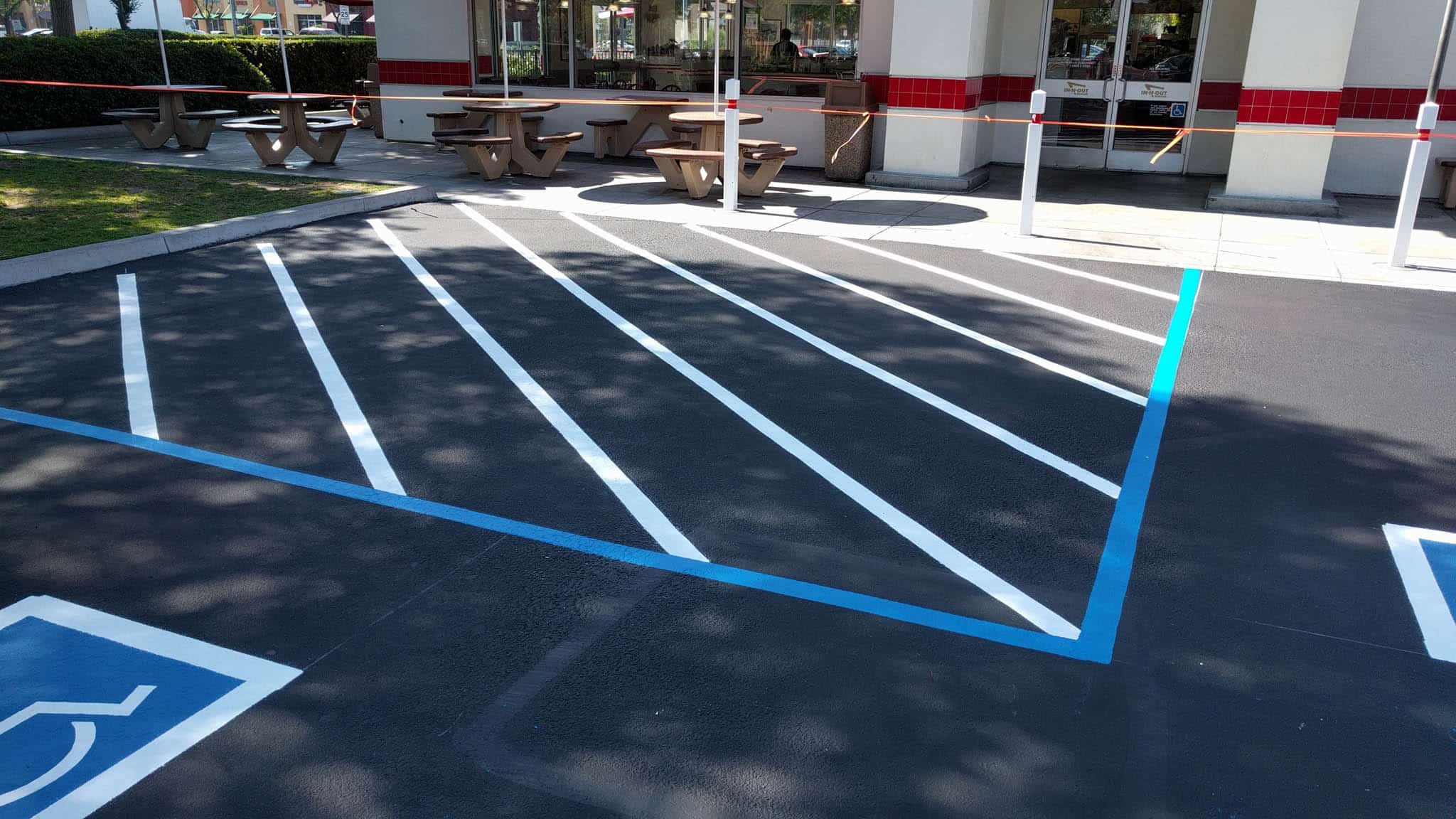
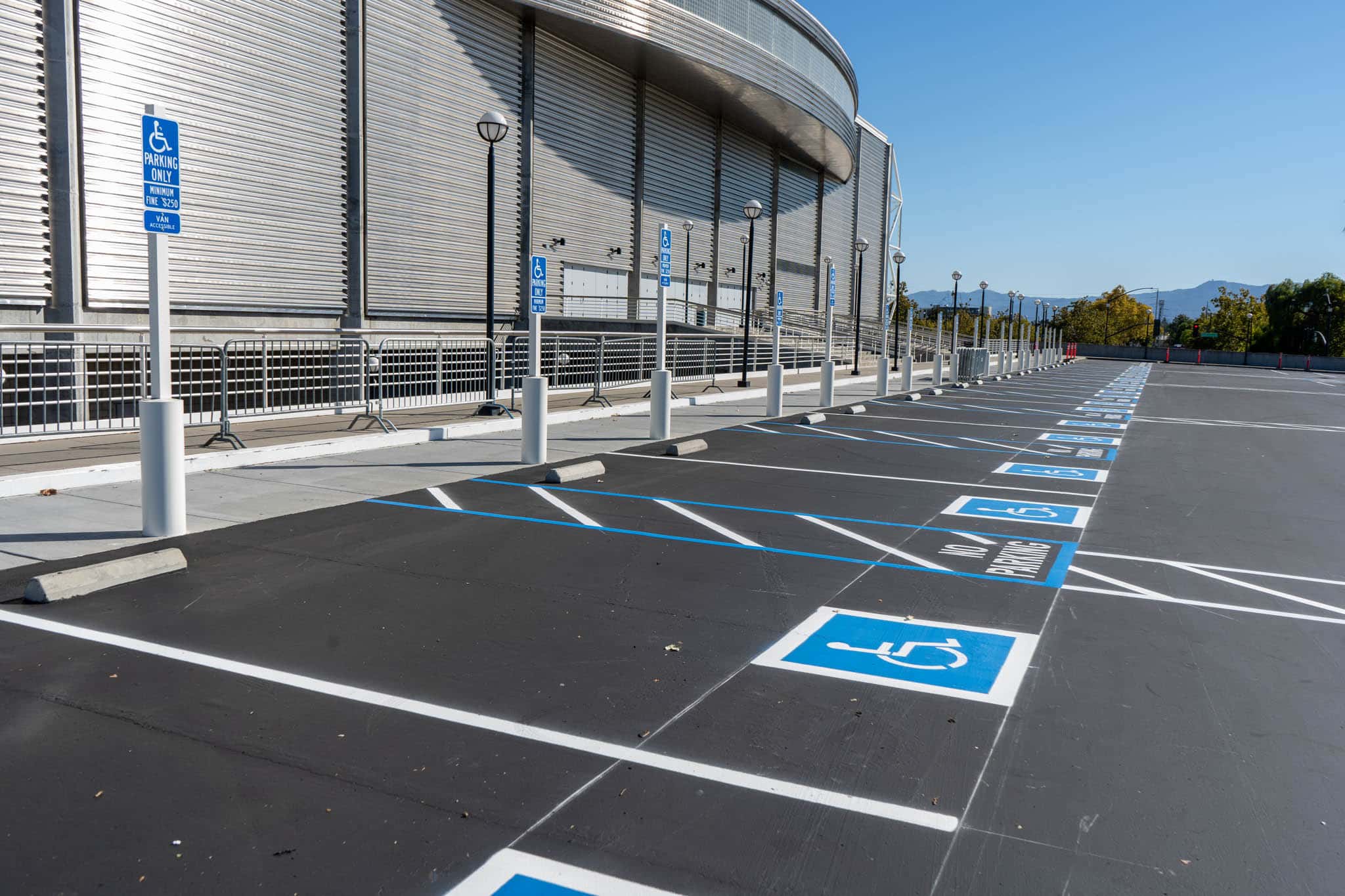
- Accessible parking:
- Businesses must provide a certain number of accessible parking spaces, which are typically located close to the entrance. These spaces must include access aisles to accommodate wheelchair transfers and must be clearly marked with ADA-compliant signage.
- Ramps and pathways:
- Where stairs are present, businesses must also provide ramps or elevators. Accessible ramps should have a slope of 1:12 and feature landings if they exceed a certain length. Pathways should be wide enough to allow easy navigation for individuals using mobility aids.
- Signage and wayfinding:
- ADA-compliant signage must be used throughout the property, including for accessible parking spaces, entrances, exits, restrooms, and other important locations. Signs should be placed at accessible heights and include raised characters or Braille where necessary.
Specific ADA requirements for California
In addition to the federal ADA guidelines, California has its own accessibility regulations, known as the California Building Code (CBC), which sometimes exceed federal standards. Here are a few key considerations for businesses in California:
- Accessible parking:
- California requires more accessible parking spaces than the federal ADA, especially in parking lots with over 100 spaces. For example, for parking lots with 501-1,000 spaces, California requires 2% to be accessible, while the ADA only mandates 1%.
- Path of travel:
- In California, businesses must ensure that there is an accessible “path of travel” to all public areas, including restrooms, dining areas, and entrances. This path must be at least 48 inches wide in most cases to accommodate individuals with wheelchairs.
- Restroom access:
- California has stringent requirements for accessible restrooms, including specific dimensions for turning space, grab bar placement, and sink heights.
- Certified Access Specialist (CASp):
- California offers a CASp program, where trained professionals can assess and certify that a building is ADA-compliant. This certification provides protection against lawsuits for ADA violations and can demonstrate a business’s commitment to accessibility.
Why ADA compliance is important
- Legal requirements:
- Businesses are legally required to comply with the ADA. Failing to meet these requirements can result in fines, lawsuits, and injunctions. In California, where ADA lawsuits are particularly common, businesses are frequently held accountable for non-compliance.
- Inclusivity and social responsibility:
- Meeting ADA standards demonstrates a commitment to inclusivity and equality. It ensures that people with disabilities can access and navigate public spaces just like everyone else. Businesses that prioritize accessibility send a message that they value all customers, which can enhance their reputation.
- Business opportunities:
- Approximately 26% of U.S. adults have some form of disability. Ensuring that your business is accessible widens your potential customer base. Families and caregivers also often make purchasing decisions based on a business’s accessibility, so addressing ADA compliance can help you attract more clients.
- Avoiding future costs:
- Addressing ADA compliance issues after a project is completed is far more expensive than doing it right from the start. Retrofitting non-compliant areas, like adding ramps or modifying doorways, can be a costly and time-consuming process.
Key considerations before a project begins
- Early planning for compliance:
- Addressing ADA compliance in the design phase is critical. Waiting until after construction has started or is complete often leads to expensive retrofitting and redesigns. Ensure your architects, designers, and contractors are familiar with both federal ADA guidelines and California-specific accessibility requirements.
- Accurate assessments:
- Conduct a thorough review of your property to identify any potential compliance issues before construction begins. This includes evaluating pathways, parking lots, entrances, restrooms, and interior layouts.
- Permitting and inspections:
- ADA compliance is integral to obtaining building permits and passing inspections in California. Addressing ADA requirements from the start will help streamline the permitting process, reduce the risk of project delays, and avoid fines.
- Long-term viability:
- ADA requirements are evolving. Planning your project with potential future regulations in mind will help ensure that your property remains compliant for years to come. Materials, design elements, and structural decisions should all consider the long-term durability and accessibility of the building.
The value of hiring Pacific Surfacing as your ADA compliance expert
- We have expertise in ADA and California regulations:
- ADA compliance is complex, especially in California where state regulations may differ from federal ones. We stay up to date with current laws and best practices to ensure full compliance.
- We can prevent costly mistakes:
- As a specialized contractor we are less likely to make errors or overlook critical compliance details. Mistakes in ADA compliance can lead to lawsuits or fines, so it’s crucial to get it right the first time. As experts we ensure the project is executed according to legal standards, avoiding expensive rework.
- We will save you time:
- We know the ins and outs of the law, which allows us to complete projects more efficiently. This can help your project stay on schedule by reducing the likelihood of design changes, delays in approval, or issues during inspections.
- We approach accessibility holistically:
- We don’t just look at one aspect of your project; we assess the entire job to ensure all aspects of accessibility are addressed. We offer comprehensive solutions to make your entire project compliant and accessible.
- We can give you long-term peace of mind:
- We can ensure your property remains compliant for years to come. By following the latest standards, we can also future-proof your property against potential changes in ADA laws. This saves you from costly updates down the road and ensures you maintain accessibility for all users.
Key benefits of addressing ADA compliance before a project begins
- Legal protection: Addressing ADA compliance early prevents potential lawsuits, fines, and legal issues.
- Cost savings: By incorporating ADA standards from the outset, you avoid expensive modifications and retrofits later.
- Enhanced reputation: Businesses that prioritize accessibility show social responsibility and inclusivity, helping to attract a broader customer base.
- Faster project completion: Early ADA planning can prevent delays, making the inspection and approval processes more efficient.
- Comprehensive compliance: Hiring a specialized ADA contractor ensures that your property is fully compliant.
Conclusion
Commercial ADA requirements are essential for ensuring that public spaces are accessible to everyone. In California, where regulations are particularly stringent, businesses must pay special attention to accessibility issues to avoid costly mistakes, lawsuits, and penalties. By addressing ADA compliance early in the design phase and hiring a specialized contractor, businesses can save time and money while ensuring that their property is both legally compliant and welcoming to all. The value of getting it right from the start cannot be overstated—it protects your business, enhances your reputation, and opens your doors to a larger customer base.

 https://pacificsurfacing.com/wp-content/uploads/2025/11/Trip-Hazard.jpg 1229 1638 hello@thepointcollective.com https://pacificsurfacing.com/wp-content/uploads/2025/09/PS_logo_rgb_notagline.png hello@thepointcollective.com2025-11-13 11:08:332026-09-10 11:09:32Trip hazard prevention: Keeping your property safe and ADA compliant
 https://pacificsurfacing.com/wp-content/uploads/2023/10/Pacific-Surfacing-heros-ada-compliance-10-1.jpg 1152 2048 hello@thepointcollective.com https://pacificsurfacing.com/wp-content/uploads/2025/09/PS_logo_rgb_notagline.png hello@thepointcollective.com2025-05-21 15:47:452026-09-10 12:06:49ADA-compliant ramps: Slope, surface & regulations
 https://pacificsurfacing.com/wp-content/uploads/2023/10/Pacific-Surfacing-heros-ada-compliance-2-1.jpg 1152 2048 hello@thepointcollective.com https://pacificsurfacing.com/wp-content/uploads/2025/09/PS_logo_rgb_notagline.png hello@thepointcollective.com2025-01-15 11:56:042026-09-10 12:17:18Asphalt and concrete finishing for ADA compliance
 Asphalt sealcoating excellence in the Bay Area